Competitive (or leaderboard) matches are for intermediate+ Riichi Knox players who want a little something more from our Mahjong sessions without having to put anything on the line, except pride that is! There is a separate leaderboard for both ONLINE and OFFLINE matches. It’s meant to be a moderately serious event in which four (4) players agree to play a full East-South match (hanchan) to contribute to their leaderboard ranking. All rules from setup to post-game will be outlined below. There are many reasons a player would want to partake in a leaderboard match, whether it’s a sense of pride, testing of skills, practice for tournament environments, or just because they want to feel something. As such, all players at the table should be respectful of each other’s wishes while also adhering to common tournament rules. Rolling leaderboards are posted above this paragraph. Final results will be posted at the end of each yearly quarter (ie, January-March), with your top three (3) results contributing to your score! All you need is three (3) match results to make it on the leaderboard! The top four (4) players at the end of the season can play an untimed East-South game, for final standing. This will take place on a Saturday evening at the end of a season. It is the players’ responsibility to make time for the match. Otherwise, they may forfeit top 4 placing. The winner of the season may pick a “local yaku” (house rule) for the next season.
The setup process for local matches is the same as usual. That is, except for one thing: find one of each wind tile and have someone put them face down and shuffle them (roll dice to determine who this is if extra fairness is desired). Then, every OTHER player will pick one of those shuffled tiles. The one who shuffled the tiles will get the remaining one. The player who drew the East tile will be the first dealer. The other players should orient themselves according to their wind tile in relation to the dealer.
• Make sure to place the wind indicator near the FIRST dealer so everyone can easily keep track of what the current hand is (ie, East 3), when to switch the prevalent wind to South, and who is the last dealer.
• Remind players to put out Honba & to collect Honba when applicable.
• Remind players of easily overlooked yakus like Menzen Tsumo, Ippatsu, Pinfu, and Tanyao.
• Kandora is flipped immediately after the player who Kan’d draws from the dead-wall. Regardless of what type of Kan.
• The wall is shortened by one tile every time someone calls “Kan”. Essentially, replacing the tile drawn from the dead-wall with one from the livewall.
• Make sure to report the game to a group organizer.
• Starting Points: 30,000
• Target Points: 30,000
• Match Timer: 90 Minutes
• (Optional) Player Timer Per Hand: 5 Minutes
• Uma [1st: +15, 2nd: +5, 3rd: -5, 4th: -15] (tied players split points)
• Leaderboard equation: (player score – 30,000) / 1,000 + uma
• Rounded (Kiriage) Mangan: ON
• Red Fives: ON
• Uradora/Kandora: ON
• Ippatsu: ON
• Open tanyao (All Simples): ON
• Open Riichi (2 han), Yakuman for unforced deal-in: ON
• Swap Calling: OFF
• Abortive draws: OFF
• Mangan at draw: ON
• If a player wins on dead-wall draw from an open kan, the player who gave them the kan pays the full hand value.
• Known as “pao”; If a player contributes to a Yakuman hand’s last meld when the rest of a Yakuman is open, that player is liable to pay out in case of the Yakuman winning from “tsumo”. In the case of the hand winning through “ron” from another player, the player who contributed to the Yakuman AND the player who played into “ron” split the cost.
• If situations arise without a clear rule in this document, call for judge or consult the World Riichi Championships 2025 Ruleset PDF
• Before the first hand, it’s polite to say “Good Luck!” or “Onegaishimasu!” (おねがします)
• Tiles and equipment should be handled with care
• Only draw, discard, and riichi with one hand
• Do not discuss your own or anyone else’s hand (including what it could be)
• Naturally, intentional cheating could get you ejected and banned
• Always keep the winning tile separate from your hand
• Make sure to maintain clarity when drawing, deciding, and discarding
• You may ask the other players in between hands to count their score
• Before “all last” players should count up their score for other players to calculate how much is needed to overtake.
Dead Hand:
| Taahai and shouhai | Hands too long or too short (greater or less than 13 tiles) |
| Saki tsumo | Tile draw taken before the previous participant has discarded |
| Swap Calling | After a pon or chii, the discarded tile could have formed a tile group with tiles in the open call. Example: chii on 234 and discarding 5 |
| Karakoui | Any canceled verbal action, including winning calls. Example: declaring pon, only to decline |
| Improper winning calls | Incorrect call for ron instead of tsumo and vice versa. |
| Saku koui (improper actions) | Mistakes on open calls. Example: declaring pon with the intent to chii, or chii declared but unable to complete the call. Discarded tile should be returned to its original position. |
Chombo:
| Dead hand violation | Invoking tile calls while in dead hand |
| Improper Hand | Winning hand declared and displayed while noten, furiten, no yaku, etc. |
| Noten riichi | Non-tenpai riichi revealed at exhaustive draw – or at any time to the table |
| Illegal kan after riichi | Invalid kan discovered at exhaustive draw |
| Illegal wall breaking | Wall broken before point exchanges are resolved, where winning shapes and/or ura dora are unclear |
| Intentional tile display | Intentionally showing tiles from the walls or one’s own hands – per referee discretion |
| Intentional chonbo | The penalty is tripled, and the offender’s qualification is questioned |
| Multiple chonbo | All penalized |
| Knocking over the wall | If more than six (6) tiles are knocked over from the wall, chombo is paid out. If less than six, appears to be an accident, and it’s the first offense, simply restack and continue. |
| Chonbo during “headbump” | The chombo is canceled, and the valid win is assessed |
| Chonbo is paid out as a “reverse tsumo mangan”. If Chombo occurs, the current hand ends, and the hand is replayed, whether the offender is the dealer or not. No wind rotation, no honba increase. | |
For penalties that are not outlined here, that you’d like to utilize, consult the WRC Penalties 2025 document.
Due to the nature of online Riichi, the process is much simpler compared to playing a match in person. One player needs to create a Mahjong Soul “Friendly Match” and copy the rules from the screenshots below! Of course, all players must agree beforehand that the game will be for the leaderboard!
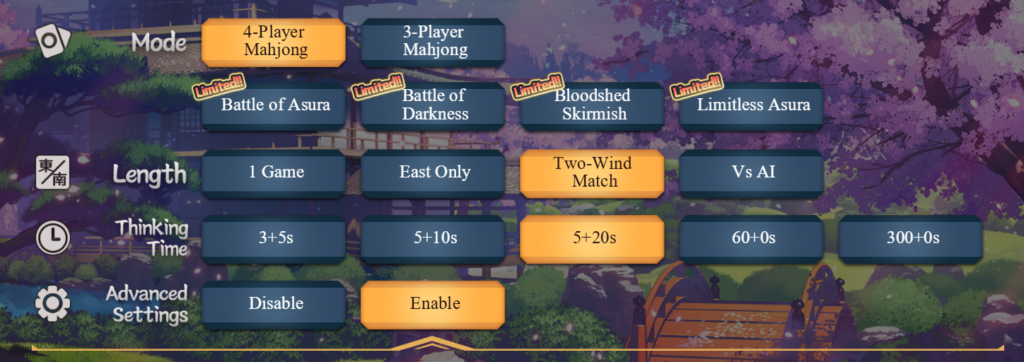
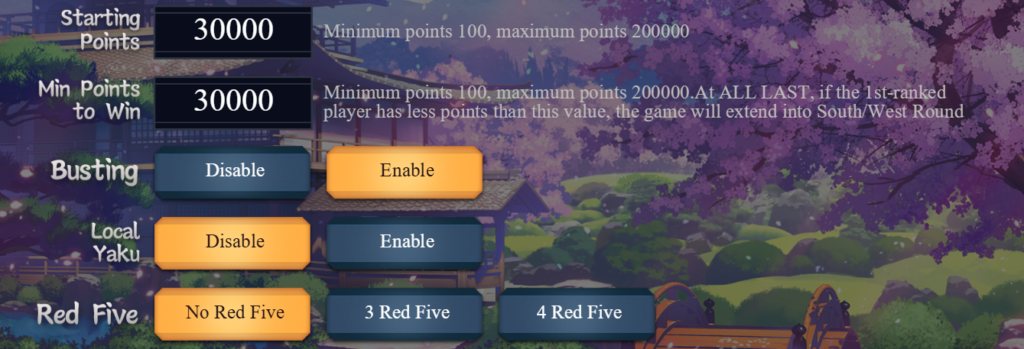
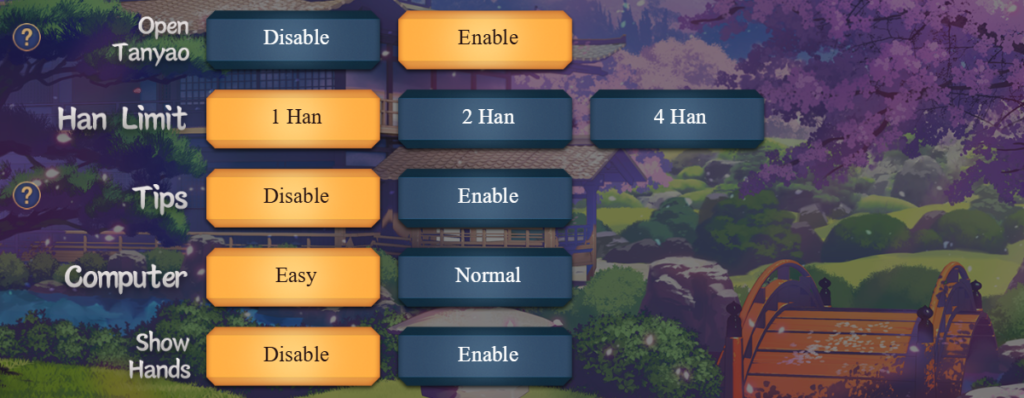
Rules Written Out:
• Mode: 4 players
• Length: Two-Wind Match
• Time: 5+20s
• Advanced Settings: Enable
• Starting Points: 30,000
• Target Points: 30,000
• Busting: Enable
• Local Yaku: Disable
• Red Five: 3 Red Five
• Open Tanyao: Enable
• Han Limit: 1 Han
• Tips: Disable
• Show Hands: Disable
• Computer Opponents: None
• Uma [1st: +15, 2nd: +5, 3rd: -5, 4th: -15] (tied players split points)
• Leaderboard equation: (player score – 30,000) / 1,000 + uma
ONCE COMPLETE, MAKE SURE TO SEND A SCREENSHOT OF THE RESULTS TO AN ORGANIZER!!!